In this article
- What Groundworks Actually Involve
- Why Groundworks Are More Important Than the Surface
- Key Elements of Groundworks Explained
- What Most Homeowners and Developers Get Wrong
- How Professional Groundwork Makes a Difference
- Real Life Example
- When Groundworks Require Extra Attention
- Why Groundworks Should Never Be Overlooked
- Conclusion
- Frequently Asked Questions
When planning a construction or driveway project, most people focus on what they can see. The surface, the finish, and the final result.
What often gets overlooked is what happens underneath.
Groundworks form the foundation of any successful project, yet they are one of the most misunderstood parts of construction. A project may look complete on the surface, but without proper groundwork, problems can develop much sooner than expected.
Companies such as Batten Civil Engineering regularly deal with issues caused by poor groundwork, showing just how important this stage really is for long-term performance.
What Groundworks Actually Involve
Groundworks are not just about digging and preparing land. They involve creating a stable and reliable base that supports everything built on top.
This stage requires careful planning, the right materials, and proper execution to ensure the structure remains stable over time.
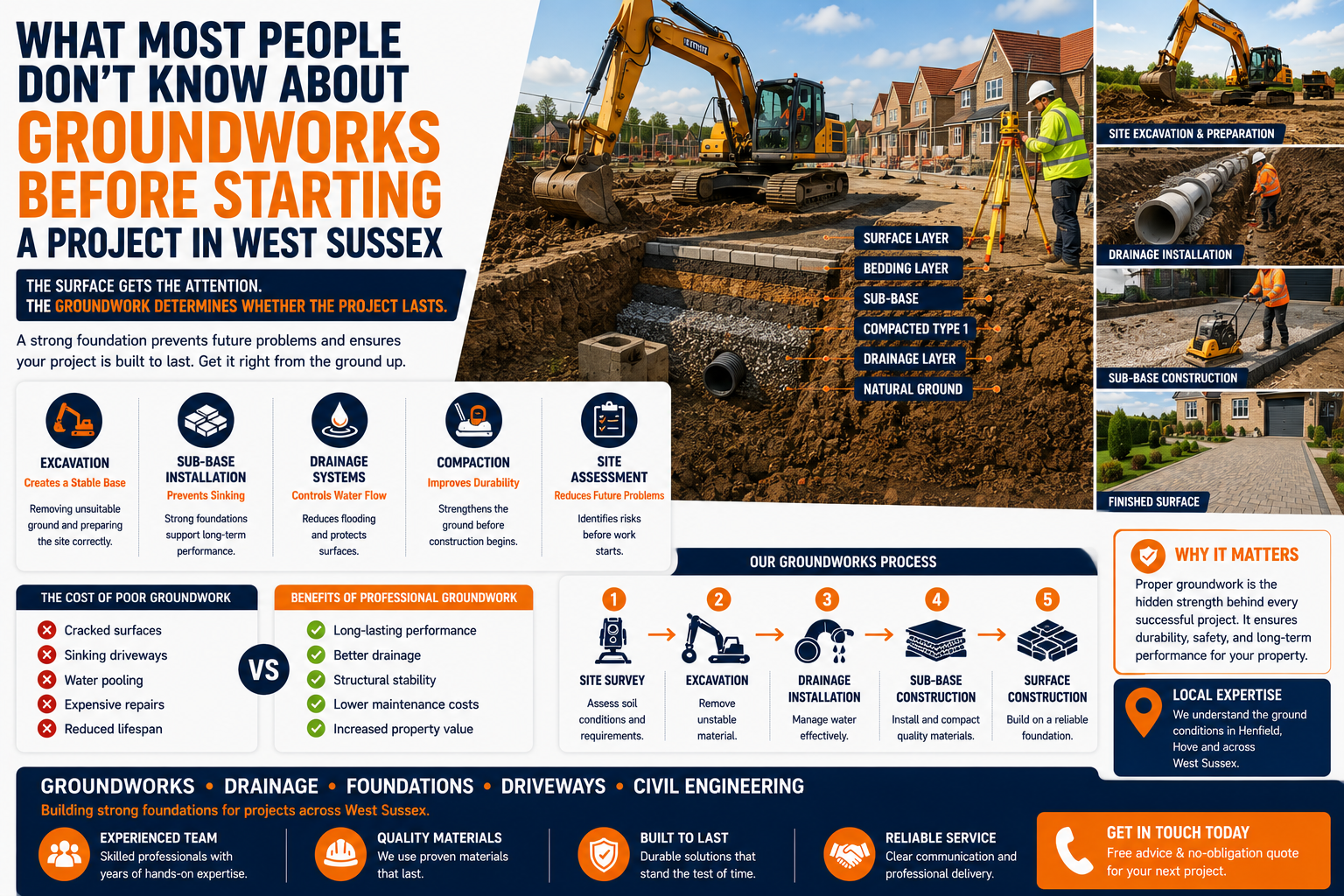
Typical groundwork tasks include site clearance, excavation, installation of sub-base layers, drainage systems, and ensuring proper levels and compaction. Each step plays a key role in building a strong foundation.
Why Groundworks Are More Important Than the Surface
It is easy to focus on materials like block paving, resin, or tarmac, but these are only as strong as the base underneath.
A well-installed surface can still fail if the groundwork is not done properly. This is one of the most common issues seen in both residential and commercial projects.
Poor groundwork can lead to:
- Cracking and sinking surfaces
- Water pooling and drainage problems
- Uneven or unstable driveways
Addressing these risks early ensures the final result lasts significantly longer and performs as expected.
Key Elements of Groundworks Explained
Understanding the main components of groundworks helps explain why this stage is so important.
| Element | What It Does | Why It Matters |
| Sub-base | Supports the surface above | Prevents sinking and movement |
| Drainage | Controls water flow | Avoids flooding and damage |
| Excavation | Removes unsuitable soil | Creates a stable base |
| Compaction | Strengthens the ground | Improves durability |
Each of these elements must be completed correctly to ensure long-term stability and performance. The Construction Industry Training Board (CITB) outlines that groundwork competency is one of the most skill-intensive areas of the construction trade, requiring trained operatives and proper supervision.
What Most Homeowners and Developers Get Wrong
Many issues arise from simple misunderstandings about how groundwork works.
One of the most common mistakes is assuming that groundwork is a quick or minor step. In reality, it is one of the most important stages of the entire project and often requires the most precision.
Another issue is choosing contractors based purely on cost. While this may seem like a saving upfront, it often leads to shortcuts in preparation, which can cause problems later.
Other mistakes include poor drainage planning, incorrect excavation depth, and using low-quality base materials. These issues are not always visible immediately, but they tend to appear over time.
How Professional Groundwork Makes a Difference
A properly executed groundwork phase sets the standard for the entire project.
Experienced contractors assess the site carefully and adapt their approach based on soil conditions, drainage requirements, and how the space will be used. This ensures the groundwork is suitable for long-term performance rather than just short-term results.
Professional groundwork typically focuses on:
- Correct excavation depth and preparation
- Strong and stable sub-base installation
- Effective drainage solutions
Companies like Batten Civil Engineering follow structured methods to ensure each stage is completed correctly before moving forward. You can see how this approach has been applied across different projects in their case studies.
Real Life Example
A property owner in West Sussex installed a new driveway, expecting it to last for years. However, within a short period, the surface began to sink and crack.
The issue was not the surface material itself. It was the groundwork underneath.
After bringing in a professional contractor, the existing surface was removed and the ground was properly re-prepared. A new sub-base and drainage system were installed before the surface was relaid.
The result was a stable and long-lasting driveway, demonstrating how critical proper groundwork is from the start.
When Groundworks Require Extra Attention
Some projects require additional care due to site conditions or usage.
This is particularly important for sloped areas, locations with poor soil, or properties where heavy vehicles are regularly used. In these cases, standard groundwork approaches may not be sufficient.
According to NHBC guidance on substructure and groundworks, ground conditions must be properly assessed before any foundation or base layer work begins, particularly on sites with variable or unstable soil. Adapting the groundwork to suit the environment ensures better performance and reduces the risk of future issues.
Why Groundworks Should Never Be Overlooked
Groundworks may not be visible once the project is complete, but they determine how well everything performs over time.
Ignoring this stage can lead to ongoing maintenance issues, reduced lifespan of the surface, and additional repair costs.
Working with a reliable contractor such as Batten Civil Engineering helps ensure that every project begins with a solid and dependable foundation. To discuss a project in West Sussex, you can get in touch through the Batten Civil Engineering contact page.
Conclusion
Groundworks are the most important part of any construction or driveway project, even though they are often overlooked.
A strong foundation ensures durability, stability, and long-term performance.
By understanding the importance of proper groundwork and working with experienced professionals, you can avoid common problems and achieve results that last.
Frequently Asked Questions
What are groundworks in construction?
Groundworks involve preparing the land and foundation before building or surfacing begins.
Why are groundworks important?
They ensure stability, proper drainage, and long-term durability of the project.
Can poor groundworks cause damage?
Yes, it can lead to cracking, sinking, and drainage issues.
How long do groundworks take?
It depends on the size and complexity of the project.
Do I need a professional contractor for groundworks?
Yes, proper groundwork requires experience, equipment, and planning. You can explore what professional groundwork involves on the Batten Civil Engineering groundworks service page.
Share