In this article
- What Is Commercial Line Marking?
- 1. Improving Safety for Drivers and Pedestrians
- 2. Reducing Congestion in Commercial Car Parks
- 3. Helping Warehouses and Factories Manage Vehicle Movement
- 4. Improving Traffic Flow Around Loading Bays
- 5. Making Better Use of Available Space
- 6. Supporting a More Professional First Impression
- 7. Choosing Durable Line Marking Materials
- 8. Maintaining Line Markings Over Time
- 9. Planning a Commercial Line Marking Project
- 10. Minimising Disruption While Work Takes Place
- 11. Line Marking and Workplace Safety Responsibilities
- 12. Why Choose Batten for Commercial Line Marking?
- Frequently Asked Questions
- Improve Safety and Traffic Flow With Professional Line Marking
Commercial areas often need to accommodate cars, delivery vehicles, employees, customers, pedestrians and contractors within the same space. Without a clear layout, these different activities can create confusion, congestion and unnecessary safety risks. Drivers may struggle to identify parking bays, pedestrians may cross vehicle routes unexpectedly, and delivery vehicles may block access when waiting or manoeuvring.
Commercial line marking helps businesses organise these spaces by making routes, parking areas, crossings and restricted zones easier to recognise. Clearly defined markings give drivers and pedestrians visual guidance, helping them understand where to travel, where to stop and which areas should remain clear.
For commercial property owners, facilities managers, warehouse operators and site managers, effective line marking is an important part of planning and maintaining a safe, efficient site. It can support smoother traffic movement, improve the use of available space and help create a more professional environment for staff and visitors.
Batten Civil Engineering Limited provides surfacing, civil engineering and line marking services across Sussex, Surrey, Kent and London. Through its specialist road marking service, the company undertakes projects for roads, car parks, factories, warehouses and other areas where clear, durable markings are required.
This guide explains how commercial line marking improves safety and traffic flow, which markings businesses may need and what to consider when planning a line marking project.
What Is Commercial Line Marking?
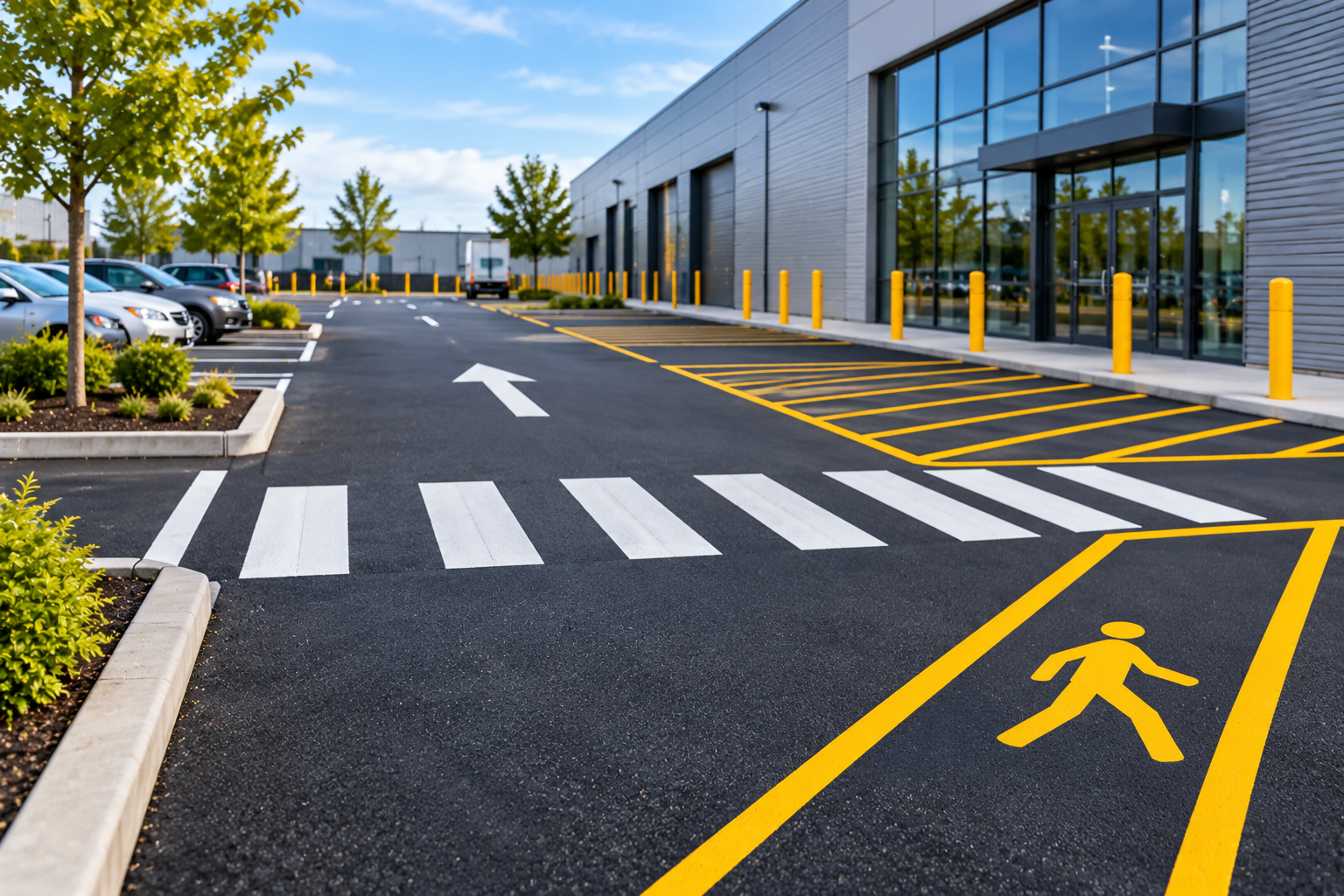
Commercial line marking involves applying visible lines, symbols, arrows and other markings to road surfaces, car parks, industrial yards and other operational areas. These markings communicate how a space should be used and help people navigate the site.
The exact markings depend on the location, the activities taking place and any applicable design or safety requirements.
Common examples include:
- Parking bay lines: Define individual parking spaces and help drivers park within designated areas.
- Directional arrows: Show the intended direction of travel through car parks and access roads.
- Pedestrian walkways: Identify routes intended for people walking through a site.
- Crossing points: Highlight locations where pedestrians are expected to cross vehicle routes.
- Loading bay markings: Identify designated areas for deliveries, loading and unloading.
- Hatched areas: Mark spaces that should remain clear for access, manoeuvring or other specified purposes.
- Stop lines and warning markings: Help communicate where vehicles should stop or exercise additional caution.
- Restricted parking markings: Identify areas where parking is prohibited or limited according to the site’s rules and applicable requirements.
- Warehouse floor markings: Help organise pedestrian routes, equipment movement, storage areas and operational zones within suitable facilities.
Line marking is most effective when it forms part of a well planned layout. Simply adding more lines does not automatically make a site safer. The markings must be easy to understand, appropriately positioned and consistent with the way people and vehicles actually use the space.
1. Improving Safety for Drivers and Pedestrians
One of the main benefits of commercial line marking is that it helps distinguish different areas of a site. In busy commercial environments, pedestrians and vehicles may operate close together, particularly near entrances, loading bays, parking areas and warehouse access points.
Without clearly defined routes, people may walk through areas used by moving vehicles, while drivers may not expect pedestrians to appear in certain locations.
Line marking can help reduce this uncertainty by identifying pedestrian walkways, crossing points, vehicle routes and restricted areas.
For example, a distribution warehouse may have delivery vehicles entering the yard throughout the day while employees walk between the warehouse entrance and staff parking area. Marked pedestrian routes can help guide employees away from vehicle movements and towards designated crossing points.
The UK Health and Safety Executive recommends separating pedestrian and vehicle routes wherever possible. Where routes cross, suitable crossing points should be clearly identified and protected as appropriate. Markings can contribute to this approach, although barriers, layout changes, signs and other controls may also be necessary.
Businesses should therefore assess how people and vehicles interact across the entire site rather than relying on painted lines alone.
Making pedestrian routes easier to identify
A marked walkway gives employees and visitors a visible indication of where they should walk. This is particularly useful at sites where pedestrians need to move between offices, entrances, staff facilities and parking areas.
Effective pedestrian routes should follow practical walking paths and minimise unnecessary interaction with vehicles. Where there is a significant risk of collision, physical separation may be more appropriate than markings alone.
Highlighting crossing points
Pedestrians sometimes need to cross a vehicle route to reach a building or another part of the site. Clearly marked crossing points can help direct people towards suitable locations and alert drivers to potential pedestrian movements.
The crossing location should provide adequate visibility, and additional measures may be required depending on traffic volume, vehicle speed and site conditions.
Communicating restricted areas
Hatched zones and other markings can identify areas that need to remain clear, such as access points, turning spaces or locations where vehicles should not park. Their meaning should be clear to everyone using the site.
When combined with appropriate signs and site procedures, these markings help communicate how the area should be used.
For official workplace guidance, businesses can consult the Health and Safety Executive’s advice on separating pedestrians and vehicles.
2. Reducing Congestion in Commercial Car Parks
Commercial car parks can become congested when parking bays, traffic routes and turning areas are poorly defined. Drivers may stop while deciding where to go, park outside designated spaces or create obstructions by waiting in areas intended for moving traffic.
Well planned car park line marking helps organise the available space and makes the layout easier to follow.
Clearly defined parking bays
Marked parking bays help drivers understand where each vehicle should be positioned. A consistent layout can reduce unnecessary gaps between parked vehicles and make the available capacity easier to manage.
Bay dimensions and layouts should be suitable for the types of vehicles using the car park. Businesses may also need designated accessible parking spaces, parent and child spaces or other specific provisions depending on the site and applicable requirements.
Directional arrows
Directional arrows can guide drivers through the car park and help establish a predictable movement pattern. In suitable layouts, a clearly marked one way system may reduce conflicting vehicle movements and unnecessary reversing.
Arrows should be positioned where drivers have enough time to see and understand the direction before making a decision.
Keeping access routes clear
Markings can identify areas that should not be used for parking, helping preserve access for deliveries, emergency arrangements, pedestrian routes and vehicle manoeuvres.
The design should reflect how the site operates during busy periods, not just how it looks when the car park is empty.
For a retail park, this might mean keeping pedestrian routes clear near entrances and directing vehicles towards appropriate parking areas. For an office complex, it may involve organising staff parking, visitor spaces and delivery access separately.
A clearer layout can help reduce confusion and make the car park easier to use. Actual improvements depend on the design, traffic levels, signage and how consistently site rules are followed.
3. Helping Warehouses and Factories Manage Vehicle Movement
Warehouses and factories often combine vehicle traffic, pedestrians, materials handling equipment, storage operations and delivery activities. These movements may take place inside buildings, in external yards or across several connected areas.
Industrial line marking can help identify operational zones and make the intended movement patterns easier to understand.
Depending on the site, markings may be used to define:
- Pedestrian walkways.
- Forklift and other vehicle routes.
- Storage and staging areas.
- Loading and unloading zones.
- Restricted access areas.
- Equipment operating zones.
- Crossing points between pedestrian and vehicle routes.
- Areas that need to remain clear for access or emergency arrangements.
For example, a warehouse may have forklifts moving goods between storage racks and loading doors. Marked pedestrian routes can help direct employees towards designated walkways rather than through operational areas.
The layout must still account for vehicle turning circles, visibility, load dimensions, doorways and other physical constraints. Markings that look clear on a drawing may be unsuitable if they place pedestrians too close to reversing vehicles or obstruct normal equipment movements.
Facilities managers should review the site with the people who use it, including warehouse staff, drivers and health and safety representatives where appropriate.
Why consistency matters
When markings change from one area to another without a clear reason, workers may find it harder to understand the layout. A consistent marking system can make routes and restricted areas easier to recognise.
However, colour alone should not be relied upon to communicate every instruction. The meaning of markings should be supported by suitable signs, symbols, training and site procedures.
Line marking should also be reviewed when operations change. New equipment, altered storage arrangements or additional vehicle movements may require the layout to be updated.
4. Improving Traffic Flow Around Loading Bays
Loading and unloading areas are often among the busiest parts of a commercial site. Delivery vehicles need enough room to approach, position themselves, unload goods and leave without obstructing other traffic.
If these areas are not clearly organised, vehicles may queue in unsuitable locations, block pedestrian access or interfere with other deliveries.
Line marking can help identify designated loading bays, waiting areas, turning zones and routes into and out of the loading area.
Designating loading spaces
Clearly marked loading bays help drivers identify where deliveries should take place. This can make it easier for site managers to direct incoming vehicles and reduce the likelihood of deliveries being carried out in unsuitable areas.
Supporting manoeuvres
Directional arrows and route markings can help drivers understand how to approach and leave the loading area. The design should account for the size and type of vehicles expected to use the site.
Large vehicles may require additional turning space and may create visibility problems when reversing. Markings should therefore be considered alongside the physical layout, suitable signage, barriers and traffic management procedures.
Protecting pedestrian access
Staff may need to walk near loading bays to reach warehouse doors, offices or other facilities. Clearly identified walkways and suitable crossing arrangements can help reduce unnecessary interaction between pedestrians and moving vehicles.
Where the risk is significant, separate routes or physical barriers may be required.
A well organised loading area can support more predictable vehicle movements and reduce avoidable obstructions. It cannot remove all traffic risks, so businesses should regularly review the arrangement as delivery patterns change.
5. Making Better Use of Available Space
Commercial land is valuable, and businesses often need to accommodate parking, deliveries, pedestrian access and operational activities within a limited area.
A well designed line marking layout can help make the purpose of different spaces clearer and support more efficient use of the available surface.
For example, faded or poorly aligned parking bays may leave inconsistent gaps between vehicles. A redesigned layout can establish clearer boundaries and improve how drivers position their vehicles.
Similarly, a warehouse yard may benefit from clearly separated waiting areas, loading zones and vehicle routes. This can help prevent vehicles from occupying space needed for other operations.
Before redesigning a site, however, businesses should consider more than the number of spaces that can be marked.
The layout must allow safe access, appropriate vehicle movement, pedestrian routes, accessible parking provisions and any necessary operational clearances. Maximising parking capacity should not come at the expense of safety or compliance.
A site assessment can help identify where markings need to be refreshed, where the layout creates confusion and whether more substantial changes are necessary.
6. Supporting a More Professional First Impression
The condition of a commercial car park or industrial entrance can influence how customers, visitors, employees and business partners perceive a site.
Faded parking lines, unclear arrows and inconsistent markings may make the area look poorly maintained. Visitors may also struggle to locate suitable parking or understand where to enter the premises.
Fresh, clearly laid out markings can help create a more orderly appearance.
This is particularly relevant for:
- Retail parks and shopping centres.
- Office buildings and business parks.
- Hotels and leisure facilities.
- Industrial estates.
- Warehouses and distribution centres.
- Commercial premises with regular customer visits.
Line marking works best when it is part of a wider maintenance plan. The underlying surface should be in suitable condition, and markings should be coordinated with any planned resurfacing or repairs.
If a car park has potholes, extensive cracking or surface deterioration, repainting the lines alone will not resolve those issues. The surface may need patching or resurfacing before new markings are installed.
Batten provides road and car park surfacing services alongside line marking, helping commercial clients consider related surface works as part of the same project where appropriate.
7. Choosing Durable Line Marking Materials
The performance of line markings depends on the material, the condition of the surface, the preparation method and the demands placed on the area.
Commercial sites may experience frequent vehicle movements, turning tyres, heavy deliveries, weather exposure and repeated cleaning. A marking system needs to be appropriate for these conditions.
Batten’s line marking service states that its road marking projects are carried out using thermoplastic. Thermoplastic markings are commonly used for road and other traffic applications where durable, clearly visible markings are required.
What is thermoplastic line marking?
Thermoplastic road marking material is applied in a heated state and forms a marking as it cools. Depending on the product and application, it can provide a durable, raised marking that is suitable for various traffic environments.
The material and installation method should be selected for the project rather than assuming that one system is suitable for every surface.
Why surface preparation matters
Markings need a suitable surface to adhere properly. Dirt, loose material, moisture or a deteriorated substrate can affect the result.
Before installation, the contractor should assess the surface and determine whether cleaning, preparation or repairs are required.
Visibility and reflectivity
Some markings use glass beads or other features to improve visibility, particularly under vehicle headlights. The appropriate specification depends on the intended use, location and project requirements.
Businesses should ask the contractor which marking system is proposed, how the surface will be prepared and what maintenance the finished markings may need.
For further information about Batten’s approach, visit its dedicated line marking service page.
8. Maintaining Line Markings Over Time
Even durable markings can deteriorate. Regular traffic, turning movements, weather, surface wear and cleaning methods can gradually reduce their visibility.
Faded markings may become difficult to distinguish, especially in poor lighting or when the surface is wet. If drivers cannot easily identify the intended routes, the original benefits of the layout may be reduced.
Commercial property managers should therefore include line marking in routine site inspections.
What should inspections look for?
Check whether:
- Parking bay lines remain clearly visible.
- Directional arrows can be understood easily.
- Pedestrian walkways are identifiable.
- Crossing points remain clear and visible.
- Restricted areas are still marked correctly.
- Loading bays remain suitable for current operations.
- Surface deterioration is affecting the markings.
- Changes to site use have made the existing layout unsuitable.
The frequency of inspections should reflect how heavily the site is used and the risks involved. A busy distribution centre may need more frequent checks than a small car park with limited traffic.
Repaint or redesign?
Sometimes the existing markings simply need refreshing. In other cases, the layout itself may need to change because the site has introduced new operations, changed parking arrangements or experienced repeated traffic conflicts.
Repainting an unsuitable layout will not resolve the underlying problem. A review can help determine whether the best solution is maintenance, redesign or a combination of both.
Where surface damage is also present, line marking may need to be coordinated with patching or resurfacing to avoid carrying out the same work twice.
9. Planning a Commercial Line Marking Project
A successful line marking project begins with understanding how the site operates. The objective is not just to apply paint or thermoplastic but to create a layout that is visible, practical and appropriate for the people using it.
Step 1: Assess the current site
Identify faded markings, confusing routes, poorly defined parking areas and locations where pedestrians and vehicles interact. Consider how traffic behaves during the busiest periods.
Step 2: Identify operational requirements
Establish what the site needs to accommodate. This may include staff and visitor parking, deliveries, emergency access, pedestrian movement, accessible spaces and industrial vehicle routes.
Step 3: Review safety risks
Assess the risks associated with vehicle movements, reversing, crossing points, blind corners and loading areas. Decide whether markings are sufficient or whether barriers, signs, layout changes or other controls are needed.
Step 4: Plan the layout
Work out where lines, arrows, bays, crossings and restricted zones should be placed. The layout should be clear to first time visitors as well as regular users.
Step 5: Check the surface
Determine whether the existing surface is suitable for marking or requires cleaning, repairs or resurfacing first.
Step 6: Agree materials and timing
Discuss the proposed marking material, preparation requirements, programme and any restrictions on access. Consider how the work can be scheduled to minimise disruption.
Step 7: Arrange traffic management
Agree how vehicles and pedestrians will be kept away from the working area. Confirm how access will be maintained or temporarily redirected while the work takes place.
Step 8: Inspect the finished work
Check that the agreed markings have been applied in the correct locations, are clearly visible and match the approved layout. Resolve any identified issues before the project is considered complete.
A planned approach can reduce uncertainty and help the finished layout support day to day operations.
10. Minimising Disruption While Work Takes Place
Commercial sites cannot always close completely while maintenance is carried out. Retail parks, industrial premises, offices and distribution centres may need to retain some access for customers, employees or deliveries.
The extent of disruption depends on the size of the area, the material being applied, the preparation required and the time needed before the markings can be used.
Businesses should discuss scheduling options with their contractor. Where the layout permits, work may be divided into phases so that parts of the site remain available.
For example, a car park could be divided into sections, with one area temporarily closed while another remains in use. This needs careful planning to ensure temporary routes remain safe and easy to understand.
Before work begins, businesses should communicate:
- Which areas will be unavailable.
- Where temporary parking is permitted.
- How deliveries and collections will be managed.
- Which pedestrian routes should be used.
- Whether access arrangements will change.
- When the marked areas are expected to reopen, subject to the contractor’s instructions.
Freshly applied markings should not be driven over until the contractor confirms that they are ready for use. Temporary barriers, signs and traffic controls should remain in place as required.
Good coordination helps reduce avoidable disruption while ensuring that the work area remains appropriately controlled.
11. Line Marking and Workplace Safety Responsibilities
Line marking can support workplace transport safety, but it should not be treated as a complete safety solution by itself.
Businesses should consider the full system of controls used to manage vehicles and pedestrians. This includes the site layout, traffic routes, visibility, lighting, signs, physical separation and the behaviour of people using the premises.
The Health and Safety Executive advises that workplace traffic routes should be appropriately indicated where necessary and that signs and markings should be clear, visible and maintained.
Depending on the location, businesses may also need to consider applicable road marking standards, accessibility requirements, planning conditions and other legal or technical requirements.
The correct markings can vary between a private car park, a public road, a factory floor and a warehouse yard. Businesses should not assume that the same design or colour convention is appropriate in every setting.
A competent contractor can help explain the marking options available, but the business remains responsible for ensuring that its site arrangements are appropriate for its activities and risks.
Read the Health and Safety Executive’s guidance on signs, signals and road markings for further information.
12. Why Choose Batten for Commercial Line Marking?
Selecting a contractor with relevant experience can help businesses plan line marking around their existing surfaces, traffic movements and operational requirements.
Batten Civil Engineering Limited is a family run company established in 1993. The company provides surfacing, civil engineering and line marking services across Sussex, Surrey, Kent and London.
Its line marking service covers applications including roads, car parks, playgrounds, factories and warehouses. Batten also states that its road marking contracts are undertaken by its associated company, Batten Road Marking.
For commercial clients, the ability to discuss line marking alongside surfacing and related civil engineering works can be useful when a site requires more than repainting existing lines.
Before arranging a project, businesses should explain the location, surface condition, types of traffic using the site and the outcomes they want to achieve. This helps establish whether the work involves refreshing existing markings, creating a new layout or coordinating line marking with surface repairs.
Batten invites customers to request a free, no obligation quote. You can learn more about its line marking services or contact the team through the Batten website.
Frequently Asked Questions
How does commercial line marking improve safety?
Commercial line marking identifies vehicle routes, pedestrian walkways, crossing points, parking spaces and restricted areas. It helps people understand how the site should be used and can reduce confusion when combined with appropriate traffic management and physical safety measures.
What types of businesses need commercial line marking?
Line marking can benefit retail parks, office buildings, warehouses, factories, distribution centres, industrial estates and other commercial premises where vehicles and pedestrians share or move through outdoor or indoor spaces.
Can line marking improve traffic flow in a car park?
Yes. Clearly defined parking bays, directional arrows and restricted areas can make a car park easier to navigate. The actual benefit depends on the layout, traffic volumes, signs and how consistently the site rules are followed.
What is thermoplastic line marking?
Thermoplastic line marking uses a heated marking material that cools and forms a durable marking on a suitable surface. It is commonly used for road marking applications, although the appropriate material depends on the location and project requirements.
How often should commercial line markings be renewed?
There is no single renewal interval for every site. Markings should be inspected regularly, with the frequency based on traffic levels, weather exposure, surface condition and the importance of the routes. Repainting or redesign may be needed when markings become unclear.
Should a car park be resurfaced before new line markings are applied?
Not always. If the existing surface is in suitable condition, it may be possible to refresh or replace markings without resurfacing. However, extensive surface damage may need to be repaired first so the finished markings have an appropriate base.
Can line marking work take place while a business remains open?
In some cases, work can be completed in phases to maintain access to parts of the site. The arrangement depends on the layout, the work involved and the traffic management measures needed to protect workers, employees and visitors.
Does line marking alone make a workplace safe?
No. Markings are one part of workplace traffic management. Businesses may also need physical barriers, suitable signs, lighting, separate pedestrian routes, staff training and other measures identified through their risk assessment.
Where does Batten provide line marking services?
Batten Civil Engineering Limited states that it covers Sussex, Surrey, Kent and London. Contact the company to confirm availability for your specific location and project.
Improve Safety and Traffic Flow With Professional Line Marking
Clear line marking helps commercial sites organise parking, guide vehicle movements and identify pedestrian routes. When planned around the site’s actual operations, it can reduce confusion, support safer movement and make busy areas easier to navigate.
The most effective results come from combining suitable markings with a practical site layout, visible signs, appropriate traffic management and regular maintenance. Businesses should also check whether the existing surface needs repair before new markings are installed.
If your commercial car park, warehouse, factory or access road needs new markings or a layout refresh, Batten Civil Engineering Limited can help you explore the available options.
Visit Batten’s line marking service page to learn more and request a free, no obligation quote.
Share