In this article
- What Groundworks Actually Involve
- Why the Base Matters More Than the Finish
- Ground Conditions in West Sussex
- How the Groundwork Process Works
- Groundworks vs Surface: What Matters More
- A Real Example of Groundwork Importance
- Common Mistakes That Lead to Problems
- Why an Engineering Approach Makes a Difference
- Benefits of Proper Groundworks
- Conclusion
- Frequently Asked Questions
When planning a new driveway in West Sussex, it is easy to focus on the finished look. However, the real strength of any driveway comes from what lies beneath the surface.
A driveway that looks perfect on day one can quickly develop problems if the groundwork has not been done correctly. Issues like cracking, sinking, and poor drainage usually start below the surface. That is why experienced contractors like Batten Civil Engineering treat every driveway as a complete engineering project, not just a surface installation.
What Groundworks Actually Involve
Groundworks form the foundation of the entire driveway. This stage prepares the site and ensures the surface has a stable base to sit on.
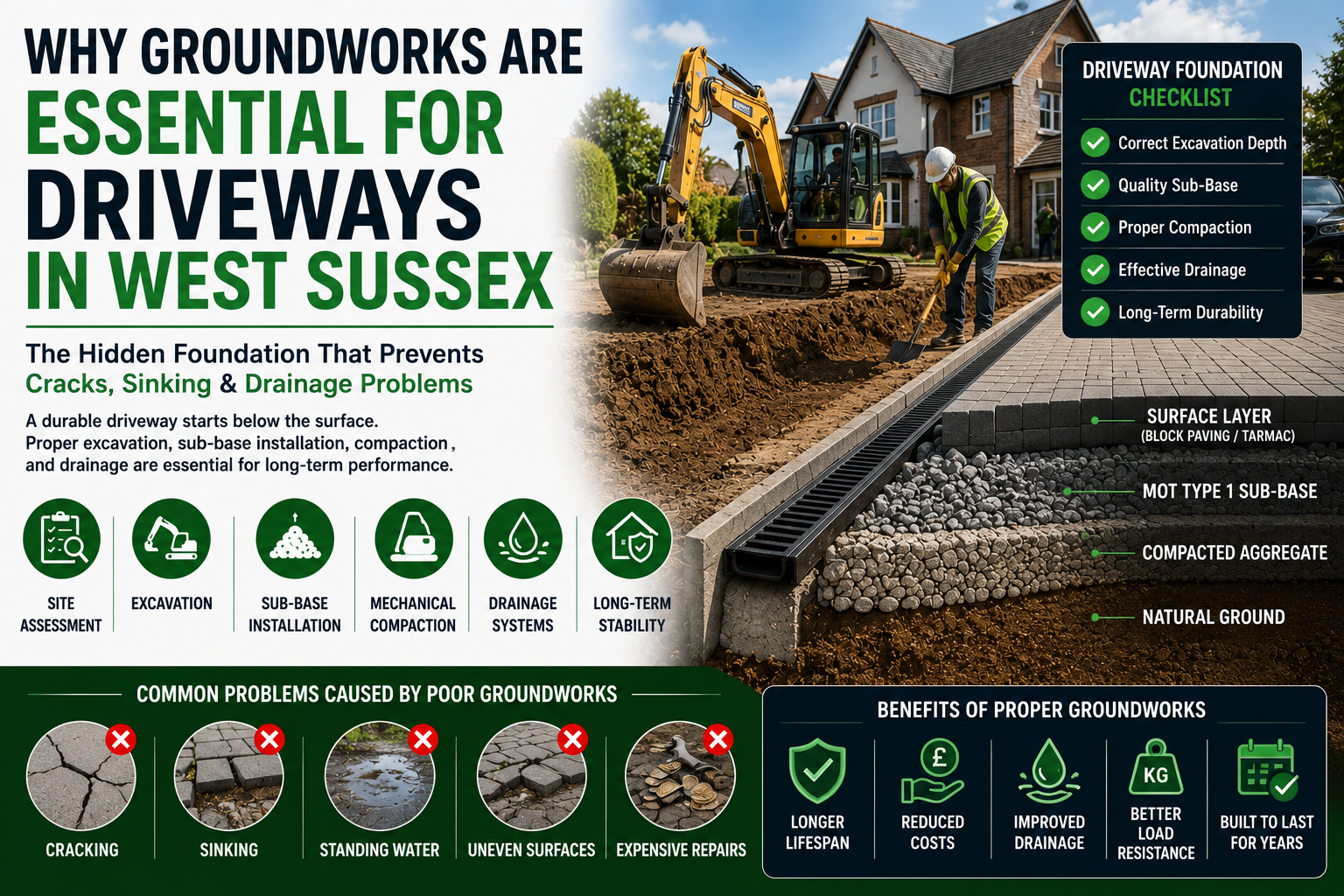
It typically includes clearing the area, excavating to the correct depth, installing a sub-base, compacting the material, and setting up drainage systems. Each step supports the next, creating a structure that can handle daily use and environmental stress.
Without this stage being done properly, even premium materials will fail over time.
Why the Base Matters More Than the Finish
Many people assume the surface material determines durability, but the base underneath plays a much bigger role.
When groundwork is poor, several problems can develop:
- Uneven or sinking areas
- Cracks appearing in the surface
- Water pooling after rainfall
A strong foundation prevents these issues and allows the surface to perform as expected for years. UK drainage rules (Planning Portal)
Ground Conditions in West Sussex
Ground conditions across West Sussex vary, and this directly affects how a driveway should be built.
Some areas have clay-heavy soil that expands and contracts, while others may suffer from water retention or uneven terrain. These conditions influence excavation depth, material choice, and drainage design.
A contractor with local experience can assess these factors early and adapt the groundwork process to suit the environment. SuDS guidance (CIRIA official)
How the Groundwork Process Works
A structured process is essential for consistent and long-lasting results.
The installation usually begins with a full site assessment, followed by excavation to remove unsuitable material. A strong sub-base is then installed and compacted to create stability. Drainage is added at this stage to control water flow.
The key stages include:
- Site assessment and planning
- Excavation to the correct depth
- Sub-base installation (e.g. MOT Type 1 explained gov.uk standards context)
- Mechanical compaction
- Drainage system setup
Only after these steps are completed does the surface installation begin.
Groundworks vs Surface: What Matters More
Understanding the difference between groundwork and surface helps explain why preparation is so important.
| Element | Role in Project | Long-Term Impact |
| Surface | Visual appearance | Limited durability alone |
| Groundworks | Structural foundation | Critical for longevity |
A driveway may look good initially, but without proper groundwork, that quality will not last.
A Real Example of Groundwork Importance
A homeowner in West Sussex experienced ongoing driveway issues, including sinking and water pooling. While the surface appeared to be the problem, the real issue was the lack of proper groundwork.
After a full reconstruction, the process included correct excavation, installation of a solid sub-base, and proper drainage. Once the new surface was laid, the driveway remained stable and performed reliably.
This highlights how important the hidden layers are in determining long-term results.
Common Mistakes That Lead to Problems
Many driveway failures can be traced back to early decisions. Some of the most common mistakes include:
- Choosing contractors based only on price
- Not excavating deep enough
- Using low-quality sub-base materials
- Skipping proper compaction
- Ignoring drainage requirements
Avoiding these mistakes is key to ensuring a driveway that lasts.
Why an Engineering Approach Makes a Difference
Not all contractors follow the same approach. Some focus mainly on the final appearance, while others prioritise structure and performance.
An engineering-based approach considers load-bearing capacity, soil conditions, and water management. This ensures the driveway is not only visually appealing but also built to handle real-world conditions.
Batten Civil Engineering applies this method to every project, combining technical knowledge with practical installation.
Benefits of Proper Groundworks
Investing in high-quality groundwork provides clear long-term benefits. A well-prepared base reduces the need for repairs and helps maintain the driveway’s structure over time.
Key advantages include:
- Longer lifespan of the driveway
- Reduced maintenance and repair costs
- Improved drainage and water control
- Better resistance to heavy use and weather
This makes groundwork one of the most valuable parts of the entire project.
Conclusion
Groundworks are the most important part of any driveway, even though they are not visible once the project is complete.
They determine how stable, durable, and reliable the driveway will be over time. A properly prepared base prevents common issues and ensures long-term performance.
In West Sussex, working with an experienced contractor like Batten Civil Engineering ensures your driveway is built on a strong and reliable foundation from the start.
Frequently Asked Questions
What are groundworks in driveway installation
Groundworks include excavation, sub-base installation, compaction, and drainage preparation before the surface is laid.
Why are groundworks important
They ensure stability, prevent sinking, and extend the lifespan of the driveway.
What happens if groundwork is poor
You may experience cracks, uneven surfaces, and drainage problems.
How deep should a driveway be excavated
It usually ranges from 150mm to 300mm depending on ground conditions.
Do all driveways need drainage
Yes, proper drainage is essential to prevent water damage and long-term issues.
Share