In this article
- A Practical Guide from Batten Civil Engineering
- What Groundwork Means for Driveways and Road Projects
- Why Proper Groundwork Matters
- The Groundwork Process for Driveways and Roads
- Groundwork Challenges in West Sussex
- Residential and Commercial Groundwork
- Common Groundwork Mistakes
- How Much Does Driveway Groundwork Cost in West Sussex?
- Choosing the Right Contractor
- Frequently Asked Questions
- Conclusion
A Practical Guide from Batten Civil Engineering
When planning a new driveway, access road, or paved area, most of the focus goes to the finished surface. Resin, tarmac, or block paving usually take centre stage.
What often gets overlooked is what sits underneath.
From experience working on driveway and road projects across West Sussex, most surface failures can be traced back to poor groundwork rather than the material itself. If the base is not prepared correctly, issues like sinking, cracking, and drainage problems tend to follow sooner rather than later.
Batten Civil Engineering works across Henfield, Hove, and surrounding areas, delivering groundwork and surfacing solutions designed for long-term performance. This guide explains how proper groundwork is carried out and why it plays such a critical role.
What Groundwork Means for Driveways and Road Projects
Groundwork for driveways and roads is different from general construction groundwork.
Instead of supporting buildings, it is designed to handle constant vehicle use, exposure to weather, and changes in ground conditions over time.
It needs to account for:
- Vehicle loads and daily traffic
- Long-term durability under pressure
- Drainage and water movement
- Stability across changing seasons
In areas like West Sussex, soil conditions and drainage can vary from one site to another. That is why groundwork needs to be adapted to each project rather than treated as a standard process.
Why Proper Groundwork Matters
Many driveway and road issues seen across the region are not caused by the surface material. They are caused by what sits underneath.
Common problems include:
- Driveways sinking after a short period
- Cracks forming due to movement in the base
- Water collecting on the surface
- Uneven or unstable access areas
In most cases, the cause is straightforward. The excavation was too shallow, the sub-base was not installed properly, or drainage was not considered.
Batten Civil Engineering focuses on getting these fundamentals right from the start, as this is what determines how the surface performs over time.
The Groundwork Process for Driveways and Roads
Every project is different, but the process typically follows a structure that ensures long-term performance.
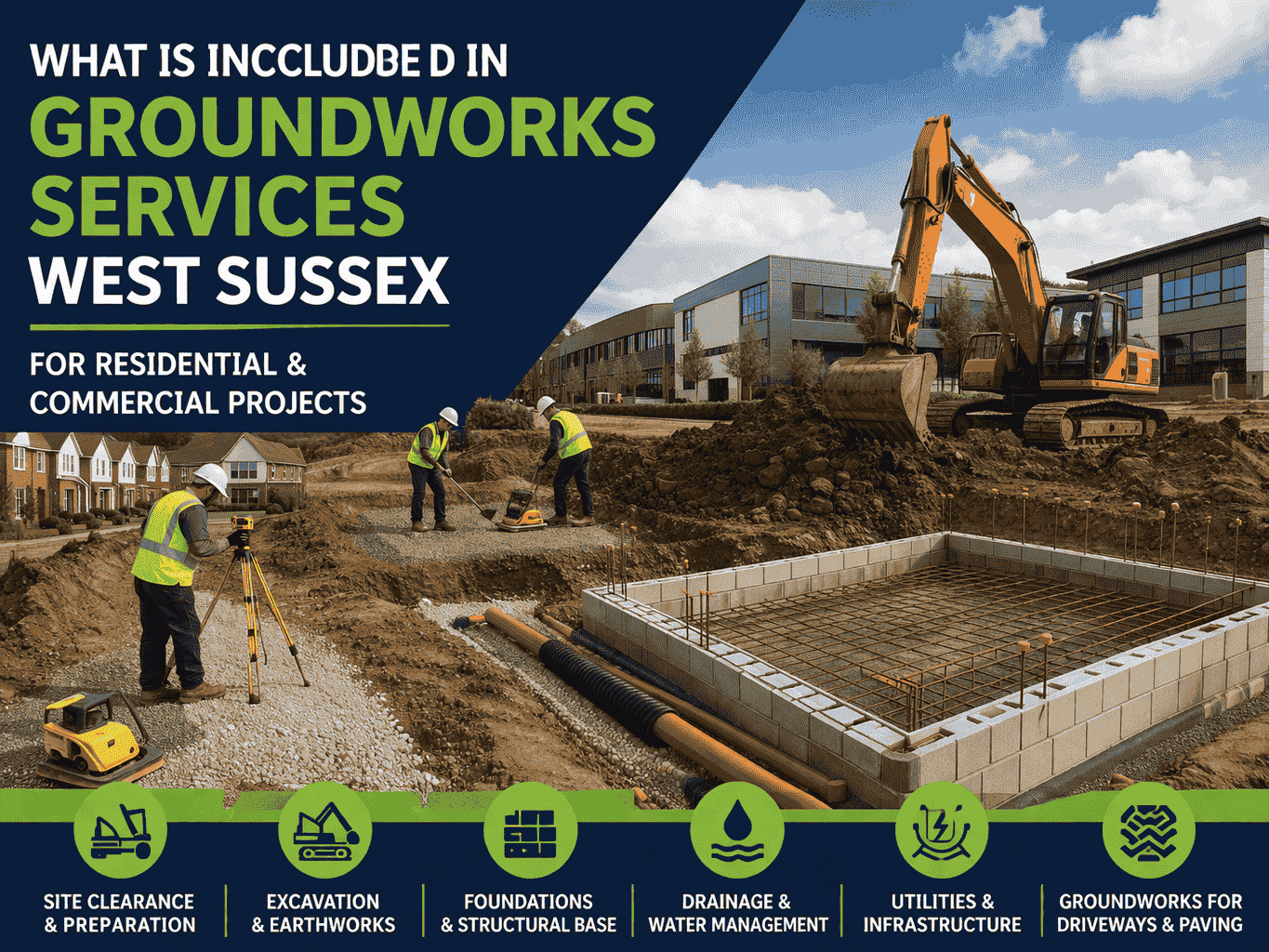
1. Site Clearance and Preparation
The first step is removing any existing surface and preparing the area.
This usually involves:
- Breaking out old or damaged driveways
- Clearing debris and unstable ground
- Setting correct levels for drainage
Problems often begin when this stage is rushed or incomplete.
2. Excavation and Sub-Base Installation
Excavation depth depends on how the surface will be used.
Domestic driveways require a different depth compared to access roads or areas exposed to heavier traffic.
A strong sub-base is then installed, typically using MOT Type 1, compacted in layers to create a solid and stable foundation.
When this stage is done correctly, it supports the surface for many years. If not, problems appear quickly.
3. Drainage and Water Management
Drainage is one of the most important parts of groundwork.
Many long-term issues come from water:
- Collecting on the surface
- Seeping into the base
- Weakening the structure
To prevent this, proper drainage solutions are built into the groundwork, such as soakaways, channel drains, and controlled water flow systems.
In West Sussex, where ground conditions vary, drainage plays a major role in surface lifespan.
4. Edging and Structural Support
Edging helps maintain the shape and strength of the driveway or road.
Without it:
- Surfaces can shift over time
- Materials can spread
- The structure becomes weaker
It is a small but essential part of the overall build.
5. Preparing for the Final Surface
Once groundwork is complete, the base is prepared for the chosen finish.
This could include:
- Tarmac
- Resin-bound surfaces
- Block paving
Each surface requires a slightly different approach, so the groundwork must be aligned accordingly.
Groundwork Challenges in West Sussex
Working across Henfield, Hove, and nearby areas, certain challenges come up regularly.
- Clay soils that expand and contract
- Sandy or loose ground requiring strong compaction
- Areas prone to drainage issues
Local experience allows groundwork to be adapted to these conditions rather than applying a one-size-fits-all approach.
Residential and Commercial Groundwork
The core principles remain the same, but requirements vary depending on usage.
Residential driveways are designed for everyday use and need to balance durability with appearance.
Commercial areas and access roads must handle heavier traffic, requiring deeper excavation and stronger base layers.
Batten Civil Engineering approaches each project based on actual usage, ensuring the final result performs as expected.
Common Groundwork Mistakes
Many issues can be traced back to a few common mistakes:
- Insufficient excavation depth
- Poor sub-base compaction
- Lack of proper drainage
- Use of unsuitable materials
These shortcuts may reduce upfront cost but often lead to more expensive repairs later.
How Much Does Driveway Groundwork Cost in West Sussex?
Groundwork costs depend on several factors, including:
- Size of the area
- Ground conditions
- Drainage requirements
- Type of surface being installed
Because every site is different, accurate pricing usually requires a proper assessment rather than a fixed estimate.
Choosing the Right Contractor
The visible finish of a driveway is important, but the groundwork is what determines its lifespan.
It is worth choosing a contractor with:
- Experience in driveway and road groundwork
- Knowledge of local ground conditions
- Ability to handle both groundwork and surfacing
- A focus on long-term durability
Batten Civil Engineering has built its reputation around these principles, focusing on proper preparation and reliable results.
Frequently Asked Questions
How deep should driveway groundwork be?
Depth depends on usage, but most domestic driveways require a properly compacted sub-base to prevent sinking and movement over time.
Why do driveways fail after a few years?
In most cases, failure is caused by poor groundwork rather than the surface material. Inadequate excavation, weak sub-base, or poor drainage are common causes.
Do I need drainage for a driveway?
Yes, proper drainage is essential. Without it, water can weaken the base and lead to long-term structural issues.
Conclusion
Planning a driveway or road project in West Sussex involves more than choosing how it will look when finished.
Groundwork is what determines how it performs over time.
Getting this stage right leads to better stability, fewer drainage issues, and a longer-lasting surface. Getting it wrong often leads to costly repairs.
If you are planning a driveway or access road project in West Sussex, working with an experienced local contractor from the start can help avoid common issues and ensure the project is built to last.
Share