In this article
- Why Industrial Estates Need Professional Commercial Surfacing
- Types of Commercial Surfacing Solutions for Industrial Estates
- Important Factors When Choosing Commercial Surfacing for Industrial Estates
- Why Line Marking Matters on Industrial Estates
- How to Minimise Business Disruption During Commercial Surfacing
- When Should an Industrial Estate Consider Resurfacing?
- How to Choose a Commercial Surfacing Contractor in West Sussex
- Why Choose Batten Civil Engineering Ltd for Commercial Surfacing?
- Commercial Surfacing Across West Sussex
- Frequently Asked Questions About Commercial Surfacing for Industrial Estates
- Arrange Commercial Surfacing for Your West Sussex Industrial Estate
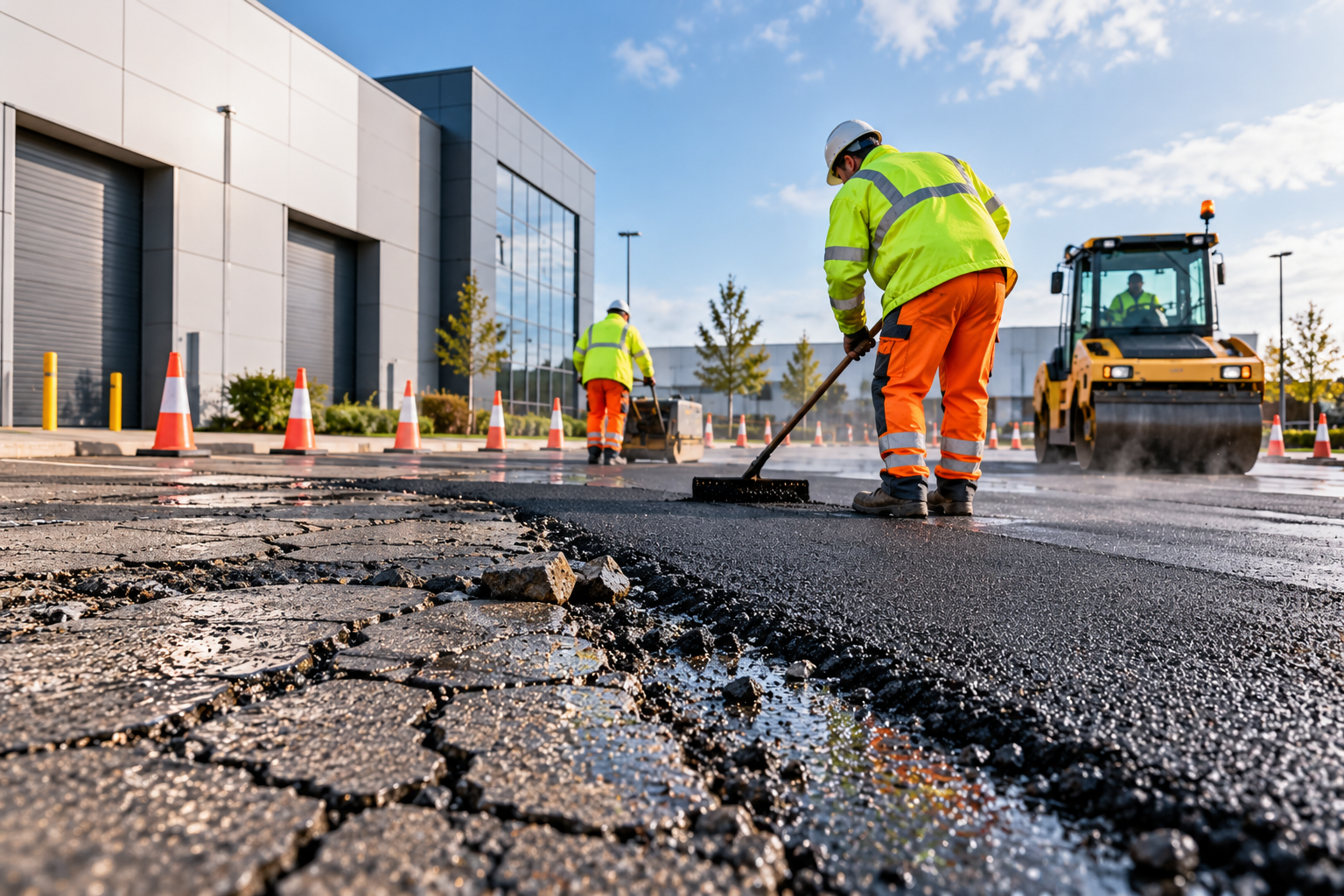
Industrial estates depend on well maintained roads, access routes, loading areas and parking facilities to keep businesses operating efficiently. From delivery vehicles entering warehouse premises to employees and visitors using shared car parks, every external surface needs to support regular traffic while remaining safe, practical and suitable for its intended purpose.
When commercial surfacing begins to deteriorate, the consequences can extend beyond appearance. Potholes, uneven asphalt, standing water, damaged kerbs and faded road markings can create problems for vehicle movements, pedestrian access and everyday business operations.
For property owners, estate managers, developers and facilities managers, investing in suitable commercial surfacing is an important part of maintaining an industrial site.
But what solutions are available, and how do you choose the right surface for an industrial estate?
Commercial surfacing projects can include new road construction, asphalt resurfacing, car park improvements, localised patching, drainage, kerbing and line marking. The appropriate solution depends on the condition of the existing surface, expected vehicle loads, ground conditions and how the site is used.
Batten Civil Engineering Ltd provides professional surfacing, groundwork and civil engineering services across Sussex, Surrey, Kent and London. With experience dating back to 1993, the company undertakes commercial projects ranging from localised repairs to larger road and car park construction.
This guide explores the main commercial surfacing solutions for industrial estates in West Sussex, the factors that influence surface performance and what businesses should consider when planning a project.
Why Industrial Estates Need Professional Commercial Surfacing
Industrial estates have different surfacing requirements from ordinary residential streets and small private driveways. Their roads and external areas may experience frequent vehicle movements, heavy deliveries, loading operations and constant use throughout the working day.
A surface that performs adequately under occasional car traffic may not be suitable for an area regularly used by heavy goods vehicles, delivery vans, forklifts and other commercial equipment.
Professional surfacing considers these operational requirements before choosing materials and construction methods.
1. Supporting Heavy Commercial Vehicles
Industrial estates often accommodate vehicles carrying substantial loads. These may include articulated lorries, delivery vehicles, construction equipment and waste collection vehicles.
Repeated traffic loading can place considerable stress on paved surfaces, particularly around turning points, loading bays, entrances and vehicle stopping areas.
If the pavement construction is not suitable for the expected traffic, the surface may develop deformation, cracking, rutting or potholes.
Commercial surfacing should therefore consider:
- The types of vehicles using the estate.
- Expected vehicle weights and loading patterns.
- The frequency of vehicle movements.
- Turning areas and delivery routes.
- The condition and strength of the existing pavement.
- The construction required to support the intended traffic.
Choosing suitable asphalt or tarmac surfacing is only part of the process. The supporting layers beneath the finished surface are equally important.
2. Improving Vehicle and Pedestrian Safety
Industrial estates are shared environments. Employees, visitors, delivery drivers and contractors may all use the same external areas.
Poorly maintained roads can create trip hazards, vehicle handling difficulties and problems with site traffic management.
Uneven surfaces, loose materials and standing water can also make everyday movement less predictable.
The Health and Safety Executive advises that workplace traffic routes should be suitable for the vehicles and pedestrians using them, with appropriate separation wherever possible.
A properly planned surfacing project can help provide smoother vehicle routes, clearer pedestrian areas and better defined access points.
3. Maintaining a Professional Business Environment
The external condition of an industrial estate contributes to the impression it creates for customers, suppliers, tenants and business partners.
Damaged tarmac, faded parking bays and neglected access roads can make a commercial property appear poorly maintained.
For estate owners and property managers, maintaining external areas can help protect the overall presentation of the development.
A well finished car park, clearly marked parking spaces and maintained access roads create a more organised environment.
4. Reducing Ongoing Maintenance Problems
Leaving small defects untreated can allow some surface problems to become more extensive.
For example, water entering cracks can contribute to further deterioration, especially when drainage is inadequate or the underlying pavement is already weakened.
Regular inspections and timely repairs can help identify problems before more extensive work becomes necessary.
Professional patching, resurfacing and drainage improvements can form part of a planned maintenance programme.
Types of Commercial Surfacing Solutions for Industrial Estates
Not every industrial estate requires the same surfacing treatment. Some developments need entirely new roads, while others require improvements to existing car parks, access routes or loading areas.
Understanding the available options helps property managers identify the work most appropriate for their site.
1. Asphalt and Tarmac Road Surfacing
Asphalt and tarmacadam are widely used for commercial roads, access routes and parking areas because they provide practical, continuous paved surfaces.
The appropriate material and pavement construction depend on the expected traffic, ground conditions, drainage and project specification.
Commercial asphalt surfacing can be used for:
- Industrial estate access roads.
- Internal vehicle circulation routes.
- Warehouse access areas.
- Commercial car parks.
- Delivery and loading areas.
- New development roads.
A properly prepared foundation and suitable installation methods are essential for long term performance.
Batten Civil Engineering Ltd provides hand and machine laid tarmacadam and asphalt surfacing for commercial and domestic projects.
Explore the company’s road and car park surfacing services to learn more about its commercial surfacing capabilities.
2. Industrial Estate Road Construction
New industrial developments and expanding commercial sites may require the construction of entirely new access roads.
These projects involve more than simply laying a finished surface. Ground preparation, excavation, drainage, pavement construction, kerbing and access arrangements may all need consideration.
A typical road construction project may include:
- Site assessment and preparation.
- Excavation and removal of unsuitable material.
- Formation preparation and compaction.
- Installation of the specified sub base.
- Construction of the required pavement layers.
- Asphalt or tarmac surfacing.
- Kerbing, drainage and associated finishing work.
The exact construction method should reflect the design requirements and intended vehicle loading.
Industrial access roads need to accommodate the largest vehicles expected to use them, including appropriate consideration of width, turning movements, gradients and visibility.
3. Commercial Car Park Surfacing
Car parks are an important part of industrial estates because they provide facilities for employees, visitors and commercial vehicles.
A damaged car park can create unnecessary difficulties, especially when parking spaces are uneven, access routes are restricted or standing water develops after rainfall.
Commercial car park surfacing can improve the condition and usability of these areas.
Typical projects include:
- New commercial car park construction.
- Resurfacing existing parking areas.
- Repairing potholes and damaged sections.
- Improving entrance and exit routes.
- Reinstating parking layouts.
- Installing or renewing surface markings.
When planning a car park project, consider the different types of vehicles that will use it. Employee parking areas may have different requirements from spaces used by delivery vehicles or maintenance equipment.
A suitable design should also consider drainage, pedestrian access and the movement of vehicles around parked cars.
4. Industrial Yard Surfacing
Industrial yards are frequently exposed to demanding working conditions.
They may be used for vehicle loading, unloading, materials storage, deliveries and machinery movements.
Unlike a conventional car park, a working yard may experience repeated turning movements, concentrated loading and the movement of heavier commercial equipment.
The pavement construction should reflect these demands.
Depending on the site, a surfacing project may involve asphalt, concrete or other suitable materials.
The choice should consider:
- Expected vehicle and equipment weights.
- Frequency of loading operations.
- Turning and braking movements.
- Ground conditions.
- Drainage requirements.
- Chemical or material exposure where relevant.
- Maintenance requirements.
A site assessment helps establish whether the existing construction is suitable for continued use or whether more extensive improvements are needed.
5. Surface Patching and Repairs
Industrial estates do not always require complete resurfacing.
Where deterioration is limited to particular sections, localised patching may provide a practical solution.
Patching involves repairing damaged areas rather than replacing the entire surface.
It can be appropriate for:
- Individual potholes.
- Localised asphalt failures.
- Damaged sections near entrances.
- Defects around drainage covers.
- Areas affected by repeated vehicle movements.
The repair method should address the condition of the damaged area and its underlying support.
Simply covering a pothole without preparing the affected section may lead to recurring problems.
Batten offers specialist commercial patching services for damaged roads and paved areas.
6. Kerbing and Drainage Improvements
Kerbing and drainage are important elements of commercial surfacing.
Kerbs help define road edges, parking areas and pedestrian zones. They can also help manage changes in surface level and direct water towards appropriate drainage points.
Drainage is particularly important on industrial estates where large paved areas can collect significant amounts of rainwater.
Poor drainage may result in standing water, water entering surface defects and deterioration of vulnerable pavement areas.
Depending on the site, improvements may involve:
- New or replacement kerbs.
- Drainage channels.
- Gullies and surface water collection.
- Adjustments to surface gradients.
- Repairs around existing drainage infrastructure.
- Reinstatement of surrounding asphalt.
Drainage arrangements should be assessed as part of the wider surfacing project rather than treated as an unrelated finishing detail.
Important Factors When Choosing Commercial Surfacing for Industrial Estates
Selecting a surfacing solution involves more than deciding whether to use asphalt or tarmac.
The contractor needs to understand how the area operates and what the finished surface must support.
Here are some of the most important considerations.
1. Traffic Volume and Vehicle Loading
The first consideration is understanding the traffic that uses the site.
An industrial estate with frequent articulated lorry movements will have different requirements from an office development with mostly employee cars.
Consider:
- Daily traffic volumes.
- Vehicle sizes and axle loads.
- Delivery schedules.
- Loading and unloading activities.
- Turning and braking locations.
- Forklift and plant movements.
These factors influence pavement design and material selection.
A suitable construction should be based on the actual demands of the site rather than a generic surfacing specification.
2. Ground Conditions and Existing Pavement
The condition of the ground beneath a road can influence its long term performance.
Weak or poorly prepared foundations may contribute to settlement, cracking and surface deformation.
Before recommending resurfacing, a contractor should assess whether the existing pavement is structurally suitable.
If the underlying construction has failed, simply installing a new surface may not solve the problem.
Depending on the findings, localised reconstruction, foundation improvements or wider pavement replacement may be necessary.
3. Weather and Water Management
West Sussex experiences changing weather conditions throughout the year, so commercial surfaces need suitable drainage and appropriate construction.
Rainwater can enter cracks and damaged areas, contributing to deterioration.
Standing water may also affect vehicle movements and pedestrian access.
A well planned surfacing project should consider:
- Surface gradients.
- Drainage outlets.
- Existing gullies and channels.
- Water collection points.
- Connections to suitable drainage systems.
- Relevant planning and drainage requirements.
The aim is to prevent water from accumulating unnecessarily and help the surface perform as intended.
4. Surface Finish and Grip
Different areas of an industrial estate may require different surface finishes.
Vehicle roads, loading areas, pedestrian routes and parking facilities do not necessarily have identical requirements.
The chosen finish should be suitable for the intended use and relevant safety requirements.
A contractor should consider vehicle movements, surface condition, drainage and the operating environment when recommending the appropriate material and finish.
5. Future Maintenance
Commercial property managers should consider how easy the finished surface will be to maintain.
A properly constructed pavement can still require periodic inspections and maintenance.
Planning ahead helps identify vulnerable areas and allows maintenance to be organised before deterioration becomes extensive.
Why Line Marking Matters on Industrial Estates
Surfacing provides the physical routes across an industrial estate, but line marking helps people understand how those areas should be used.
Clear road and surface markings can improve traffic organisation, parking arrangements and pedestrian navigation.
On busy industrial sites, these details are particularly important because different users may be moving around the property at the same time.
Organising Vehicle Movements
Line markings can identify:
- Vehicle lanes.
- Directional arrows.
- Loading and unloading areas.
- Restricted parking zones.
- Turning areas.
- Visitor parking.
- Reserved vehicle spaces.
Clear markings can help make site traffic arrangements easier to understand.
Identifying Pedestrian Walkways
Employees and visitors may need to move between car parks, warehouse entrances, offices and other buildings.
Clearly identified pedestrian routes can help distinguish walking areas from vehicle operating areas.
Where practical, pedestrian and vehicle routes should be physically separated. Markings can support this arrangement, but they should not be treated as a substitute for suitable physical protection where that is required.
Improving Parking Organisation
Industrial estates often accommodate a mixture of employee cars, visitor vehicles, delivery vans and commercial transport.
Clearly marked parking bays can help organise available space and reduce unnecessary obstruction.
Line marking can also identify disabled parking spaces and other designated areas in accordance with the applicable requirements.
Why Professional Line Marking Is Important
Markings need to be appropriate for the surface and expected traffic.
Poorly applied or unsuitable markings can fade quickly, reducing their usefulness.
Batten’s specialist line marking service covers roads, car parks, factories, warehouses and other commercial environments.
The company works with its associated road marking business, Batten Road Marking, for road marking contracts.
Find out more about its commercial line marking services.
How to Minimise Business Disruption During Commercial Surfacing
One of the biggest concerns for industrial estate managers is keeping businesses operational while construction work takes place.
Closing an entire estate or blocking important access roads may not be practical.
Deliveries, employee movements, customer visits and emergency access all need consideration.
A carefully planned project can help reduce disruption.
1. Divide the Project Into Manageable Phases
Where the layout allows, contractors may be able to complete work in sections.
For example, a large industrial estate car park could be resurfaced in separate areas rather than closed completely.
This approach may allow some parking facilities to remain available while work takes place elsewhere.
The feasibility depends on the layout, construction sequence and safety requirements.
2. Plan Alternative Access Routes
Before construction begins, identify the routes that businesses and delivery drivers will need.
Alternative access arrangements may include temporary vehicle routes, revised delivery points or adjusted parking locations.
Any temporary arrangements should be suitable for the vehicles using them and communicated clearly to site users.
3. Coordinate With Businesses and Tenants
Estate managers should inform tenants about the proposed work before construction begins.
Useful information includes:
- Planned start and completion dates.
- Areas affected by the work.
- Temporary parking arrangements.
- Changes to delivery access.
- Expected restrictions.
- Contact details for project updates.
Good communication helps businesses prepare and reduces confusion.
4. Schedule Work Around Operational Requirements
Some industrial estates experience particularly busy periods during the morning, afternoon or shift changes.
Where possible, the construction programme should consider these patterns.
The contractor and estate manager can discuss whether particular activities should take place outside peak operational periods.
However, working hours must also reflect site restrictions, safety requirements and the practical needs of the project.
5. Maintain Safe Pedestrian and Vehicle Routes
Construction work can introduce additional hazards because existing routes may be temporarily restricted.
The project team should plan safe pedestrian access, vehicle movements, signs and barriers.
The Health and Safety Executive provides useful guidance on separating pedestrians and vehicles in workplaces.
For industrial estates, appropriate traffic management should be considered throughout the project, not just after the surfacing is complete.
When Should an Industrial Estate Consider Resurfacing?
Commercial surfaces experience wear over time, but not every defect requires a complete replacement.
Recognising signs of deterioration can help property managers arrange inspections and identify suitable repairs.
Widespread Cracking
Cracks may develop due to ageing materials, water penetration, movement or problems within the supporting construction.
Isolated cracks may require localised attention, while widespread cracking may indicate a more extensive issue.
The underlying cause should be assessed before choosing a repair.
Potholes and Surface Breakup
Potholes can develop when surface materials deteriorate and lose support.
Water, repeated traffic loading and existing pavement defects may contribute.
If potholes are appearing repeatedly in different areas, it may be worth arranging a wider pavement assessment.
Standing Water
Water collecting in particular areas after rainfall may indicate poor drainage, incorrect levels or localised settlement.
Standing water can make surfaces less practical to use and may contribute to deterioration.
A contractor should investigate the cause rather than simply covering the affected area.
Uneven or Settled Sections
Settlement may occur where the supporting ground or pavement layers are not performing as intended.
This can create uneven surfaces, changes in level and difficulties for vehicles.
Depending on the severity, repairs may involve more than replacing the visible surface.
Faded Markings
Faded road and parking markings can make an otherwise serviceable industrial estate more difficult to navigate.
If traffic routes, loading bays and pedestrian areas are no longer clearly identifiable, renewing the markings may be appropriate.
How to Choose a Commercial Surfacing Contractor in West Sussex
Choosing the right contractor is an important decision for industrial estate owners and facilities managers.
Commercial surfacing requires suitable equipment, technical knowledge and experience with the types of sites involved.
Before appointing a contractor, consider the following.
Relevant Commercial Experience
Ask whether the company has experience with roads, industrial yards, warehouse access routes and commercial car parks.
Different sites have different operational demands, so experience with comparable projects can be valuable.
Range of Services
A project may involve more than surfacing.
Groundwork, drainage, kerbing, patching and line marking may all be required.
Working with a contractor that offers several related services can make project coordination more straightforward.
Suitable Equipment and Resources
The contractor should have access to equipment appropriate for the scale of the work.
Larger commercial projects may require specialist surfacing machinery, transport and other construction equipment.
Clear Project Scope
A written quotation should explain the proposed work, materials, preparation requirements and relevant exclusions.
It should also identify how additional work will be agreed if unexpected conditions are discovered.
Health and Safety Arrangements
Ask how the contractor will manage workers, site users, vehicles and visitors during construction.
Risk assessments, traffic management and appropriate working procedures are important parts of commercial project planning.
Communication and Reliability
Commercial clients need clear information about progress, access arrangements and changes to the programme.
A contractor should be able to explain the work and communicate any issues that may affect the project.
Why Choose Batten Civil Engineering Ltd for Commercial Surfacing?
Batten Civil Engineering Ltd is a family run surfacing and civil engineering company operating across the South East of England.
The business has a long history in the industry, with its current company established in 1993 and roots in the family trade extending further back.
Its services cover commercial and residential surfacing, road and car park construction, patching, groundwork, drainage, kerbing and line marking.
There are several reasons businesses may consider Batten for commercial surfacing projects.
Established Industry Experience
Batten has been operating in the surfacing and civil engineering sector for decades.
The company reports more than 10,000 completed jobs and a team with more than 250 years of combined experience.
This background supports its work across different types of surfacing and external construction projects.
Commercial and Industrial Surfacing Capabilities
The company undertakes a range of commercial surfacing work, including:
- Road construction.
- Car park surfacing.
- Asphalt and tarmacadam installation.
- Patching and resurfacing.
- Industrial crossovers.
- Kerbing and drainage.
- Groundwork and civil engineering.
These services can support different stages of an industrial estate improvement project.
Hand and Machine Laid Surfacing
Batten provides hand and machine laid tarmacadam and asphalt surfacing.
The appropriate method depends on the size, layout and requirements of the project.
Related Groundwork and Civil Engineering
A commercial surfacing project may require excavation, site preparation, drainage, kerbing and other supporting works.
Batten’s groundwork and civil engineering services cover these related activities.
You can explore its groundwork and civil engineering services for further details.
Focus on Long Term Client Relationships
Batten highlights that a significant proportion of its business comes from repeat customers and referrals.
It also emphasises its focus on quality rather than simply completing a high volume of projects.
For commercial property managers, choosing a contractor that understands the importance of consistent workmanship and communication can make a difference throughout the project.
Commercial Surfacing Across West Sussex
West Sussex includes a variety of commercial and industrial locations, each with different access, traffic and property management requirements.
Industrial and business areas around Crawley, Horsham, Chichester and other parts of the county accommodate different types of commercial activity.
Some sites primarily serve warehouses and distribution operations, while others include manufacturing units, trade counters, workshops and mixed commercial premises.
These differences influence the surfacing requirements of each property.
Commercial Surfacing in Crawley
Crawley is an important commercial and employment location in West Sussex, with business and industrial areas supporting logistics, manufacturing, offices and other commercial activities.
Industrial access roads and warehouse yards may experience frequent delivery vehicle movements.
Surfaces in these environments should be assessed with consideration for vehicle loading, turning areas, drainage and operational access.
Commercial Surfacing in Horsham
Commercial and industrial premises around Horsham may include workshops, storage facilities, trade businesses and other employment sites.
Car park surfacing, access routes and external yard improvements can help maintain practical facilities for employees, customers and deliveries.
Commercial Surfacing in Chichester
Chichester and the surrounding area contain commercial premises serving a range of industries.
Maintained access roads, parking areas and service routes are important for businesses that need reliable access for staff, customers and commercial vehicles.
Supporting Businesses Across the County
Whether an industrial property needs localised patching, a new access road, a larger car park or improvements to drainage and markings, the appropriate solution should be based on the actual condition and use of the site.
Batten Civil Engineering Ltd covers Sussex, Surrey, Kent and London. Businesses in West Sussex can contact the company to discuss project requirements and confirm service availability for their location.
Frequently Asked Questions About Commercial Surfacing for Industrial Estates
1. What is the best surfacing material for an industrial estate?
Asphalt and tarmacadam are commonly used for industrial estate roads, access routes and car parks. The most suitable material and pavement construction depend on traffic loading, ground conditions, drainage and the intended use of the area.
2. Can asphalt surfacing support heavy goods vehicles?
Yes, appropriately designed asphalt pavement construction can support heavy commercial vehicles. However, the thickness and composition of the pavement layers must reflect the expected vehicle loading and ground conditions.
3. How often should industrial estate roads be resurfaced?
There is no fixed resurfacing interval for every industrial estate. The timing depends on construction quality, traffic levels, drainage, maintenance and environmental conditions. Regular inspections can help identify when repairs or resurfacing may be needed.
4. Is patching better than complete resurfacing?
Patching may be suitable when damage is limited to specific areas and the surrounding pavement remains in reasonable condition. Where deterioration is widespread or structural problems exist, more extensive resurfacing or reconstruction may be appropriate.
5. Can commercial surfacing take place while an industrial estate remains operational?
In many cases, work can be organised in phases to maintain access to parts of the site. The feasibility depends on the layout, construction requirements and traffic management arrangements. Safety must remain the priority.
6. Why is drainage important for industrial estate surfacing?
Drainage helps prevent water from collecting on paved surfaces. Poor drainage can contribute to surface deterioration, standing water and difficulties for vehicles and pedestrians. Drainage should therefore be considered during surfacing design and maintenance.
7. Does an industrial estate need professional line marking?
Line marking can help identify parking bays, traffic routes, loading areas and pedestrian crossings. It supports a more organised site layout and can form part of wider workplace traffic management arrangements.
8. What is included in a commercial surfacing project?
Depending on the requirements, a project may include site preparation, excavation, groundwork, sub base construction, asphalt surfacing, kerbing, drainage, patching and line marking. The exact scope should be confirmed in the quotation.
9. Does Batten Civil Engineering Ltd undertake commercial surfacing in West Sussex?
Batten operates across Sussex, Surrey, Kent and London and provides commercial road and car park surfacing, groundwork and related civil engineering services. Contact the company to confirm arrangements for your particular site.
10. How can I get a commercial surfacing quotation?
You can contact Batten Civil Engineering Ltd to explain your requirements and discuss a suitable assessment and quotation. Providing information about the site, surface condition, vehicle movements and required work can help the company understand the project.
Arrange Commercial Surfacing for Your West Sussex Industrial Estate
A well maintained industrial estate needs more than a visually attractive road surface. Its access roads, loading areas, parking facilities, pedestrian routes and drainage systems must work together to support everyday commercial activity.
Choosing the right surfacing solution starts with understanding how the site is used, the vehicles it needs to accommodate and the condition of the existing pavement.
Whether you require a new industrial access road, commercial car park resurfacing, localised patching, drainage improvements or line marking, professional planning can help create a practical and durable result.
Batten Civil Engineering Ltd provides commercial surfacing, road construction, car park surfacing, groundwork and related civil engineering services across the South East, including Sussex.
With established industry experience, a range of commercial services and a focus on quality workmanship, Batten can discuss the requirements of your industrial estate project.
Planning a commercial surfacing project in West Sussex? Contact Batten Civil Engineering Ltd to discuss your requirements and request a free, no obligation quotation.
Website: https://www.battenltd.com/
Telephone: 01903 813064
Email: office@battenltd.com
Google Business Profile: https://share.google/kvm5moLDAnt0BbAbH
You can also visit the company’s Google Business Profile to find its business information and customer reviews.
Share