In this article
- A Practical Guide from Batten Civil Engineering
- Why Road Surfacing Matters More Than It Seems
- What Determines Whether a Surface Lasts or Fails
- Asphalt Surfacing for Roads in West Sussex
- Tarmac Surfacing for Car Parks and Access Areas
- Car Park Surfacing for Real-World Use
- Common Surfacing Problems and Their Causes
- When It Is Time to Resurface
- How a Professional Surfacing Project Is Carried Out
- Working with Local Conditions in West Sussex
- How Much Does Road or Car Park Surfacing Cost in West Sussex?
- Choosing the Right Surfacing Contractor
- Frequently Asked Questions
- Conclusion
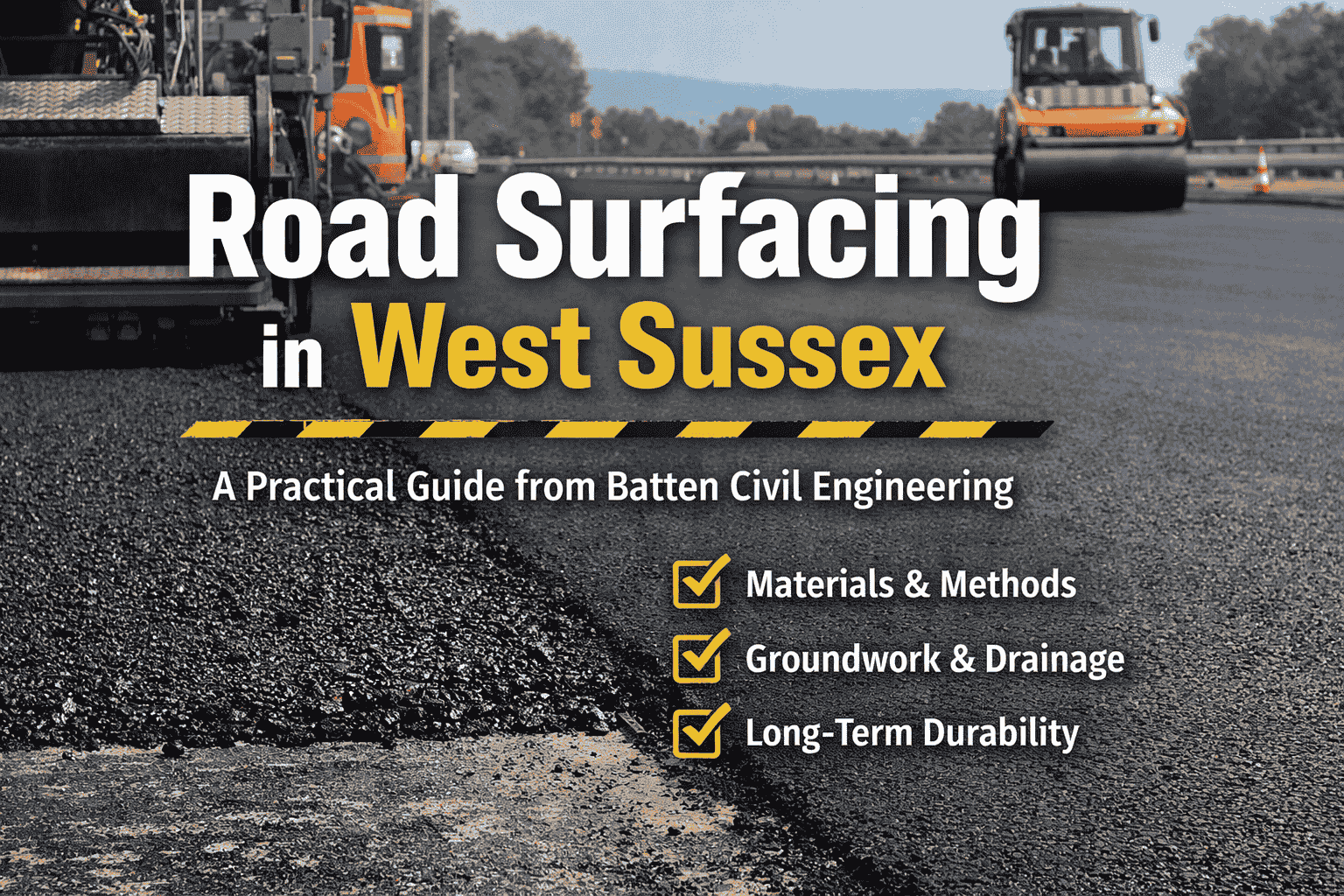
A Practical Guide from Batten Civil Engineering
Roads and car parks rarely get much attention until something starts to go wrong.
Cracks appear, potholes form, and water begins to sit on the surface. Once that happens, the problem usually gets worse quickly.
Across West Sussex, a large portion of resurfacing work comes from surfaces that were either poorly installed or not built to handle long-term use.
Batten Civil Engineering works with residential clients, businesses, and commercial sites across Henfield, Hove, and surrounding areas, delivering road and car park surfacing designed for durability, not just appearance.
This guide explains how professional surfacing works, what makes it last, and how to avoid common long-term issues.
Why Road Surfacing Matters More Than It Seems
A road or car park is constantly under pressure.
Every day it is exposed to:
- Repeated vehicle weight
- Braking and turning stress
- Rainwater and temperature changes
- Ongoing wear from daily use
Small surface issues rarely stay small. A minor crack can quickly develop into structural damage once water gets beneath the surface.
Proper surfacing protects the entire structure, not just the visible layer.
What Determines Whether a Surface Lasts or Fails
A common misconception is that the surface material alone determines quality.
In reality, most failures come down to what sits underneath.
From experience working across West Sussex, the most common causes of failure include:
- Weak or poorly prepared base layers
- Inadequate drainage
- Incorrect material selection for usage
Batten Civil Engineering approaches each project by focusing on these underlying factors first, ensuring the finished surface performs reliably over time.
Asphalt Surfacing for Roads in West Sussex
Asphalt is widely used for roads because it offers a strong balance between durability and flexibility.
It is particularly suited for:
- High traffic roads
- Commercial access routes
- Areas with heavy vehicle use
A well-installed asphalt surface provides:
- A smooth and consistent finish
- Resistance to cracking under load
- Long-term performance under pressure
However, even high-quality asphalt will fail if the groundwork beneath it is not properly prepared.
Tarmac Surfacing for Car Parks and Access Areas
Tarmac is commonly used for car parks and smaller roadways where durability and cost-efficiency are important.
It is often chosen because it:
- Handles regular vehicle movement well
- Is cost-effective for larger areas
- Allows for easier maintenance over time
Batten Civil Engineering regularly installs tarmac surfaces for:
- Commercial car parks
- Residential developments
- Private access roads
When installed correctly, it provides a practical and long-lasting solution.
Car Park Surfacing for Real-World Use
A car park is more than just a surface. It affects how a property is experienced from the moment someone arrives.
An uneven or poorly maintained car park can lead to:
- Safety risks for pedestrians and drivers
- Difficulty navigating the space
- A poor first impression
A properly surfaced car park should provide:
- Smooth and level access
- Clear layout and usability
- Effective drainage to prevent standing water
Batten Civil Engineering focuses on both performance and usability, ensuring surfaces are built for everyday use.
Common Surfacing Problems and Their Causes
Many issues seen across West Sussex come from similar underlying problems.
These include:
- Potholes forming in high-use areas
- Water pooling after rainfall
- Surfaces breaking down prematurely
- Uneven sections caused by ground movement
In most cases, these problems are linked to:
- Poor groundwork
- Lack of drainage
- Low-quality or rushed installation
Fixing these issues often requires addressing the base, not just the surface.
When It Is Time to Resurface
Surface damage usually develops gradually.
Signs that resurfacing may be needed include:
- Cracks spreading across the surface
- Potholes appearing
- Water sitting after rain
- Uneven or unstable areas
Addressing these early helps prevent more extensive and costly repairs.
How a Professional Surfacing Project Is Carried Out
A well-executed surfacing project follows a structured process.
This typically includes:
- Assessing the existing surface condition
- Removing damaged or worn layers
- Repairing or strengthening the base
- Applying new surfacing material
- Compacting and finishing the surface
The difference between long-term performance and early failure often comes down to how thoroughly these steps are carried out.
Working with Local Conditions in West Sussex
West Sussex presents a range of conditions that affect surfacing performance.
These include:
- Clay soils that can shift over time
- Areas with higher moisture levels
- Locations with varying traffic loads
Batten Civil Engineering takes these factors into account on every project, adapting the approach to suit each site.
How Much Does Road or Car Park Surfacing Cost in West Sussex?
Surfacing costs depend on several factors, including:
- Size of the area
- Condition of the existing surface
- Groundwork and drainage requirements
- Type of surfacing material used
Because each project is different, accurate pricing usually requires a proper site assessment.
Choosing the Right Surfacing Contractor
The quality of a road or car park is not just about how it looks when completed. It is about how it performs over time.
A reliable contractor should offer:
- Experience in both groundwork and surfacing
- Understanding of local site conditions
- A focus on long-term durability
- Clear planning and communication
Batten Civil Engineering has built its reputation on delivering surfaces that perform under real-world conditions.
Frequently Asked Questions
How long does road surfacing last?
With proper installation and maintenance, road and car park surfaces can last many years. Longevity depends on traffic levels, drainage, and the quality of groundwork.
Why do potholes form in roads and car parks?
Potholes usually form when water enters cracks and weakens the base, combined with vehicle pressure over time.
Is resurfacing better than full replacement?
In some cases, resurfacing is sufficient. However, if the base is damaged, a full rebuild may be required for long-term results.
Conclusion
Roads and car parks play an essential role in everyday use for residential, commercial, and public spaces.
When surfaces begin to fail, it affects safety, usability, and long-term costs.
Proper surfacing, supported by strong groundwork and drainage, ensures the surface remains stable and reliable over time.
If you are planning a road or car park project in West Sussex, working with an experienced local contractor from the start helps ensure the job is done properly and built to last.
Share